Elaine of Astolat
Le Morte d'ArthurElaine of Astolat, also called Elaine le Blank and the Fair Maid of Astolat, is the daughter of Sir Bernard and the sister of Sir Lavaine. Her unreturned love for Sir Launcelot shapes a tightly connected sequence of acts: she gives him a token for a tournament, tends him when he is wounded, asks him to make her his wife or lover, and, after he refuses, dies following ten days of grief. Her carefully arranged passage by river to Westminster turns a private attachment into a public event at King Arthur’s court.
Identity and Introduction
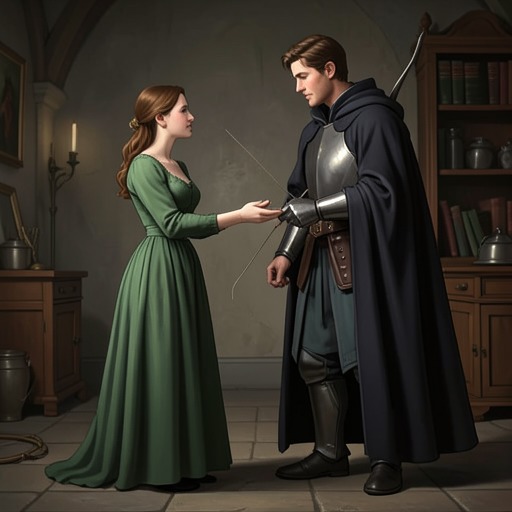
Elaine lives in the household of Sir Bernard, an old baron of Astolat. Her brother Sir Lavaine is newly made a knight and becomes a companion and ally to Sir Launcelot. When Launcelot arrives at their home before a tournament, he asks for an unrecognized shield because his own is widely known. Sir Bernard lends him a shield belonging to another son, Sir Tirre, who is unable to ride, and agrees that Sir Lavaine may accompany him.
The narrative introduces Elaine through her response to the stranger. She watches Launcelot closely and, as the account explains, falls in love with him so deeply that she cannot withdraw her affection. Launcelot, planning to compete in disguise so that his identity will not be recognized, agrees to wear a token from her. Elaine gives him a scarlet sleeve embroidered with large pearls. He has not previously worn a lady’s token, and accepts this one partly because it will help conceal who he is from his own kin. The favor thus carries two meanings: to Elaine it is a personal sign of attachment; to Launcelot it is also a device in his disguise.
Love, the Tournament, and Recognition
At Winchester, Elaine hears Sir Gawaine describe the tournament’s masked competitors. One knight wearing a red sleeve, he says, was among the best he had ever seen and unhorsed forty knights of the Round Table; his companion also performed honorably. Elaine blesses the success of the red-sleeved knight and tells Gawaine that he is the first man she has loved and will be the last. She does not know his name or origin, but insists that her love is real.
Gawaine’s account brings recognition without giving Elaine the knowledge she most wants. When she later finds Sir Lavaine at Winchester, she has learned from Gawaine that the knight with the sleeve was Launcelot. Lavaine takes her to the hermitage where Launcelot lies sick and pale. At the sight of him she faints, and, when she recovers, asks why he is in such a condition before fainting again. Launcelot receives her kindly, kisses her, and tells her not to distress herself on his account. He soon expects to recover, but regrets that Gawaine has identified him: he fears the disclosure will reach Queen Guenever and provoke anger.
Elaine stays with Launcelot and attends him day and night. The account emphasizes the constancy of this care, while also making clear that she does not know him through an established relationship: her devotion began before she knew his name. Launcelot asks Lavaine to watch for Sir Bors, who he expects will seek him, and gives him identifying details. Elaine’s loyalty is therefore enacted in the same interval as Launcelot’s concern about the courtly consequences of the red sleeve.
Launcelot’s Refusal
When Launcelot is ready to leave, Elaine asks him to have mercy on her and not let her die for love of him. Asked what she wants, she answers plainly: she wants him as her husband. Launcelot thanks her but says he has never intended to marry. She then asks whether he will be her lover; he refuses that as well, invoking his sense that accepting would repay the kindness of her father and brother badly.
Launcelot offers another form of support. If Elaine sets her heart on a worthy knight who will marry her, he will provide a thousand pounds a year for her and her heirs; while he lives, he will also remain her knight. Elaine rejects both the money and the promise of service. Unless he will marry her or become her lover, she says, her good days are over. Her request and refusal make the emotional imbalance explicit: she seeks a mutual bond, while he offers generosity and protection without either of the forms of love she asks for.
Sir Bernard tells Launcelot that he fears his daughter will die for him. Launcelot says he is deeply sorry but has not caused her love by making offers or promises, and points to Sir Lavaine as witness to his conduct. He describes Elaine as truthful, good, gentle, beautiful, and well taught, and accepts her virtue without returning her affection. Lavaine confirms her goodness and says that, since first seeing Launcelot, he too has been unable to leave him. Launcelot departs with Lavaine; King Arthur and the fellowship welcome him back, but Queen Guenever is angry and refuses to speak with him.
Death and the Journey to Westminster
For ten days Elaine neither sleeps nor eats nor drinks, and her strength declines. She makes confession and receives the sacrament, but continues to lament her love. When her spiritual adviser urges her to leave such thoughts, she defends the truth of her attachment: she has loved no one but Launcelot and, she says, has remained a pure maiden. She appeals to God’s mercy and asks that her suffering be counted in relation to her sins. Her speech gives Elaine a direct account of her own devotion and of the religious meaning she seeks in her death.
Elaine calls Sir Bernard and Sir Tirre and asks them to write a letter exactly as she dictates. She gives detailed instructions for what is to happen after her death: the letter is to be bound in her right hand while her body is still warm; she is to be laid in a fine bed with her richest clothes; then bed and body are to be placed in a chariot and taken to the Thames. There, she asks, she is to be put in a barge with only one trusted man to steer it, the vessel covered in black samite.
Her father agrees to carry out her wishes. When Elaine dies, he and her brother grieve; her body and bed are taken to the Thames, and a man sets out with her in the barge. He steers toward Westminster, rowing for some time before anyone notices the vessel. The preparations Elaine has dictated shape the manner in which her death will be encountered: her letter, clothing, bed, and covered barge carry her story beyond her household and toward the royal court.
Narrative Significance
Elaine’s story turns on a contrast between care that can be offered and love that cannot be returned. She tends Launcelot when he is ill, while he responds with gratitude, tenderness, and material provision but refuses marriage and romantic commitment. Neither her goodness nor his courtesy resolves that difference. The narrative presents her decision and suffering through her own stated wishes, while her final instructions give her a measure of control over how her death is made visible.
The red sleeve first serves as part of Launcelot’s disguise and then becomes the clue by which Gawaine identifies him. That shift exposes the limits of concealment: the token that allows Elaine to express her attachment also draws the attention that reveals Launcelot’s identity and alarms him because of Queen Guenever. Elaine’s later journey to Westminster reverses the secrecy of the tournament. She is no longer a token worn by a disguised knight; she arrives, with her letter, as the center of an event before the court.